

High Expectations and High Caring Must Go Together
Use this parenting framework to become a better leader


Probably the most humbling thing in my life so far has been learning how to be a parent. Especially when your kids are young, it feels like there’s so much at stake in everything you say to them, everything you do with them, and all the ways you respond to them. You need to model kindness and patience, but also be firm. You love them and want them to love you back, but you also need them to obey you. Especially as a new parent, it can feel like an impossible balancing act.
When I was a new parent, my dad must have seen me struggling with this because he shared some advice with me. You need to know that my dad has a PhD in psychology and, before he retired, he worked in schools for many years. So when he shares advice, it’s rarely here’s a neat trick, but instead more like here’s what the best clinical research has to say on this topic.
My dad was the one who introduced me to the work of Dr. Diana Baumrind, a clinical and developmental psychologist who studied parenting styles. I’ve read that Dr. Baumrind was the first psychologist to study not just how a mother’s parenting style affects children, but the father’s style as well.

Her most famous study identified parenting styles across two dimensions, usually called Demandingness and Responsiveness. These two dimensions become the X and Y axes in a chart with 4 quadrants, each of which represents a parenting style.
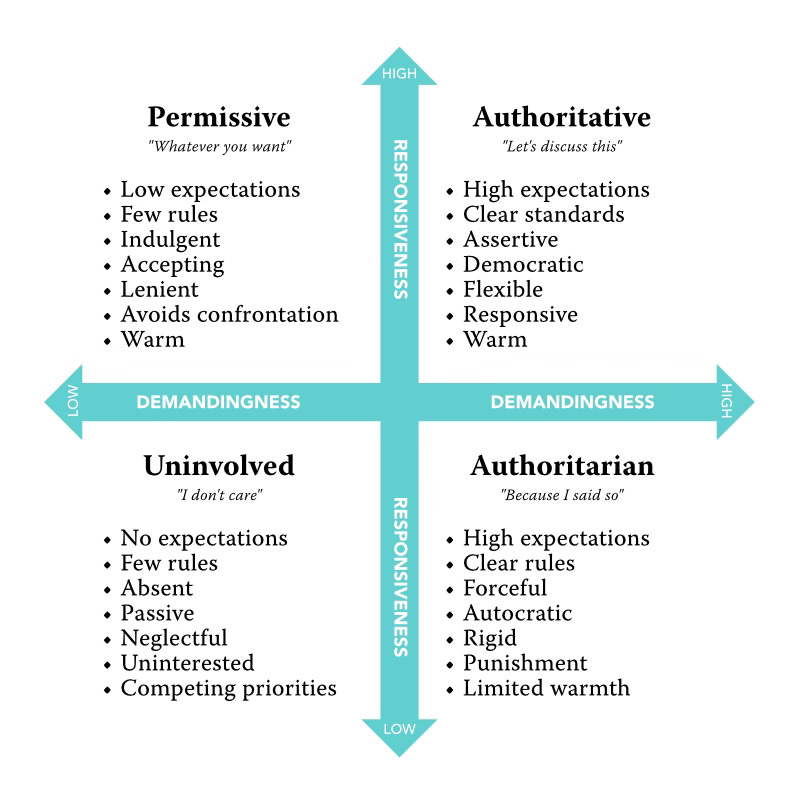
As a parent, I found this very helpful. It was naturally easier for me to be patient and tolerant with my kids and harder for me to be firm and hold to clear standards. This framework helped me understand that I needed a better balance.
Re-Applying The Framework
When I heard about this parenting framework, I was leading a team of designers that was rapidly growing, and I was thinking a lot about how to be a great people leader. It struck me that Dr. Baumrind’s framework might apply to leadership styles as well.
In my career, I’ve had leaders who I can readily place in each quadrant of this chart. Uninvolved leaders who left me to fend for myself. Permissive leaders who wanted everyone to be happy and avoided confrontation. Authoritarian leaders who expected everything to be done just the way they want. And, rarely, Authoritative leaders who clearly cared about the people on their team, engaged them, and led them to high standards of excellence.
At a gut level, it felt like this framework might hold true for manager-employee relationships just as well as parent-child ones. That said, I do not think this framework holds true because the manager-employee relationship is modeled on the parent-child relationship. Managers are not “parents”, and employees are not “children”.
Instead, I think this framework applies in both cases because it’s based on a more universal, more profound truth that applies to any relationship where one person helps another person to grow. The universal truth is that people grow when they have someone in their life who cares about them deeply and expects them to be excellent.
Also, I think this framework represents more than just a happy alignment that occurs when you mix high caring and high expectations. It means that, ideally, these two dimensions should always grow in unison
Drive up your expectations without also increasing warmth and compassion? You’ll veer toward a totalitarian culture that most people want to escape.
Drive up caring and warmth, but don’t require excellence? You’ll allow people with poor skills, low motivation, or other challenges to drag down the whole team.
Corporate Culture
My personal experience with corporate life is that senior leaders and executives are more likely to emphasize high expectations. Most senior leaders are driven, results-oriented people. Their eyes are focused on performance metrics that need to improve. From their executive-level vantage point, there are few opportunities to be warm and responsive with the hundreds of people who report to them. Also, with such a large span of control, senior leaders need to solve problems in the most scalable (read: impersonal) way possible.
In many cases, that puts middle managers into a no-win situation. They can either:
A) Emulate the priorities of their leaders, emphasizing high standards and clear expectations, since that appears to be a necessary trait to advance to higher levels of leadership. Or,
B) Provide the warmth and responsiveness that’s missing from the more senior leaders, knowing that filling that gap will help their people to grow and thrive emotionally.
My observation is that both paths can be problematic. If middle managers join with senior leaders to emphasize high expectations, then the overall culture can veer toward totalitarianism. On the other hand, if middle managers emphasize caring and warmth, they won’t be seen as a good fit for senior leadership.
I think a stronger solution is when senior leaders and middle managers—or maybe it’s better to say leaders of all roles, temperaments, and backgrounds—stretch themselves to demonstrate both dimensions. I’ve known senior leaders who make a special effort to demonstrate warmth, flexibility, and responsiveness. And the best middle managers need to combine their deep care for individuals with clear growth plans and expectations.
A Personal Case Study
In one of my past roles, my company really wanted to improve the way that teams worked with each other to identify dependencies (e.g. “my team can only get X done if your team does Y first”). As my leaders discussed this, their instinct was to roll out a new training program. As an ambitious middle manager, I volunteered to help develop this training material.
At first, we thought the training would be purely functional — how to identify the teams you should talk to, when to meet with them, and how to document the dependencies you found within our new roadmapping tool.
But as I talked to more and more teams about how they were currently working, my perception of the true problem changed. I learned that some teams were doing a great job already, largely because they had leaders who had built strong personal connections with their closest collaborators. They were skilled listeners who cared about helping other teams to succeed. However, other teams struggled because the opposite was true for them — their leaders had poor relationships with their closest collaborators, became combative when asked for support, and didn’t see how it would help to work on someone else’s problems.
After learning all this, I found it very difficult to design an appropriate training curriculum. How much value is there in teaching the functional process if the bigger problems are about communication style and values? And why are we solving this problem with a standard training program for everyone when the biggest opportunity is with a few individuals?
At the time, I didn’t perfectly understand the dynamics at play, and I did my best in the situation I was in. I designed a training program that included the functional training as we originally intended, but also specific suggestions about how to invite open dialogue and listen effectively.
In retrospect, I wish I had understood that the real problem was an imbalance between high expectations and high caring. We did need clear rules and high expectations; everyone should be held accountable to partner effectively. But that needed to be matched with personal and ongoing investment in the lives of those few challenging individuals. Growth for them, like for all of us, would require both high expectations and high caring. We needed people who would invest in them in a personal and ongoing way, not just a generic training module.
In corporate life, I think this over-emphasis on expectations (see Authoritarian in the chart above) is the more common error, but it’s just as possible to fall into traps of being Permissive or Uninvolved as well.
Lessons Learned
In the history of classroom education, certain thought leaders have always believed that new technologies would reduce or even eliminate the need for teachers. When radio was first invented, some people believed we could replace individual teachers by having only the very best teacher broadcast into every classroom in the country. Later on, people thought the same thing about TV and then the internet. I bet I could find thought leaders saying the same thing about AI right now.
Technologies can be a great help, but if you think back to the times when you grew the most, I bet you don’t think of something you heard on the radio or saw in a video or learned from ChatGPT. I bet you think of a person — a parent, a pastor, a coach, a mentor, a friend — who invested their time and attention in you. A person who made it clear that they cared about you and believed you were capable of great things.
I want to be a person like that for my kids, my friends, and my team at work. I know my habit, especially at work, is to see a problem and immediately think about how I want someone to do better (high expectations). These days, I’m training myself to think first about how I can increase my personal warmth and compassion commensurate with my expectations.
I forever have thought that most underlying problems are less about training and process and more about understanding of your role within a unit (I.e team, relationship or family) and the communication and respect that transpires. It’s a very difficult thing to teach.
This was really insightful, as someone interested in leadership. Also, very thought provoking. I see the parent-child dynamic that emerges in the workplace less as informed by parenting styles and more as informed by attachment theory and trauma projection. I've found this understanding has helped me to guide others to greater self-awareness and improved this dynamic. I'd like to think this would emerge as more of a co-active leadership style, depending on the unique needs of each direct report, but it sounds like that might be too idealistic on my part. I'd love to hear your thoughts. I can't wait to read more of these!